"It's as if a great bird lives inside the stone of our days and since no sculptor can free it, it has to wait for the elements to wear us down, till it is free to fly." Mark Nepo

Sunday, August 19, 2012

Solo


Deciding to solo in last night's performance was like so many choices in life: You say a reluctant yes, believing you can change your mind at any time, when in reality the yes refuses to be so easily undone.

I'm a new drummer. An accidental drummer, truth be told. Walt and I started classes with Clifford at the beginning of March. We had such a great time with the first one, we took a second, and a third. The only option for summer drumming was a performance class, so we signed up for that, trusting Clifford's right hand Audra when she said we'd do well and it would be fun.

And it was so much fun. Learning whole rhythms that involved not only the djembes we play, but also dununs, the bass drums of Western African drumming. Meeting new people. Getting to know new friends better. Feeling like a real drummer, with a true sense of the music, the beat, the complex weaving of sounds.

From the beginning Clifford talked casually about the fact that he wanted us each to at least consider soloing for the performance. Part of one class session was spent practicing both individual and group solos, with nothing decided about who would or would not do a solo at the end.

At another session closer to the actual performance date, he asked us all to try a solo during practice. Nothing big, just a couple of good hits to mark our place and intention. After we'd all survived that, he asked us who wanted to solo for at least one of our three rhythms at the performance. Mine was the next to last hand in the air.

I didn't want to solo. But neither did I want to be the only person who didn't solo—yes, there apparently is an adolescent alive and well inside. Plus I was hooked by the challenge of it, and maybe lulled by Clifford's easy confidence that we couldn't fail. Mostly, though, I agreed because I was so afraid of soloing. And I figured it wouldn't be too bad to hit a few quiet notes for one rhythm from the safety of our line of djembe players.

Then Clifford told us we needed to play loudly enough that we could be heard over the other drums when we soloed. Once we'd practiced a few times with very short  and sufficiently loud solos, he mentioned that it would be a good idea if we each stepped forward when it was our turn. When we all managed that without trauma, he added that we could play a solo for all three of our rhythms if we wanted.

No place to hide.

The thought of the performance itself didn't make me nervous at all. I practiced nearly every day and listened to recordings of our classes when I wasn't practicing. My handing and tones improved noticeably from week to week, and although I knew I wasn't even close to sounding like Clifford or Audra or any of the  drummers in the advanced class, I felt confident that I would hold my own in the group.

The thought of soloing was another story. It wasn't really something I could practice because it was supposed to be from the heart—my own personal rhythm in response to the larger rhythms being played around me. In order to solo, I had to be willing to step toward an audience, away from the safety of the group, and do my best knowing best would be far more about enthusiasm and guts than skill.

When my turn came last night, the first solo in our second rhythm, I stepped forward and made myself look into the audience. Where I saw two of my brothers and a sister-in-law smiling wildly, cameras at the ready. Where I saw my dear friend Daune and her husband and daughter with faces full of curiosity and kindness. I smiled back and  gave myself over to a nervous, short and sufficiently loud rhythm. When I stepped back into the safety of the line with the warmth of Walt's approval to my immediate left and the palpable love of my friends and family to the front, I felt the same sense of satisfaction I'd felt earlier in the summer at the end of our day in Actun Tunichil Muknal.

There was a second solo for the last rhythm, also short, also nervous, and nothing like the intricate and wonderful performances of both my husband and the more experienced drummers in the group. My success came not in the quality of my rhythms, but in my willingness to open the door for them to emerge. My willingness to be seen as less than perfect (even though I do really know perfection is a toxic myth). My willingness to celebrate my particular place in this process of learning without feeling the shame I often do that I'm not somewhere farther ahead.

Monday, August 13, 2012

Climbing


We sat outside the Tillamook Cheese Factory savoring rich ice cream and the perfect coast weather when Lisa asked if I'd ever been to Pacific City. We were on an adventure at the beach with the plan of continuing north to wander Manzanita and Cannon Beach. Pacific City was to the south, but the possible adventure of dune climbing at Cape Kiwanda made the change of plans an easy decision.

She knew of a place by the dune that stood above a crevasse where the ocean had cut through the sandstone. It had seemed magical to her, even in the fog of the day she was there—a place that might receive a hearts' desire and return it fulfilled beyond the asking. It was a perfect destination for two friends who hold each other's dreams as close as their own, whose times together are always gifts of discovery.

Our trudge up impossibly steep and loose sand in the sunny salt air was invigorating. Instead of arriving at the edge of the crevasse, we found ourselves at a fence with a sign warning us that to proceed was extremely dangerous. Even that far back from the edge, I felt the first stirrings of vertigo, my body's warning system warming up. We both held rocks gathered at a beach on the way intended to hold the wishes we were going to send into the crevasse and out into the universe. I decided that neither a fence nor my fear would interfere with our intentions.

I found a spot to duck under the heavy wire, leaving my shoes behind and proceeding carefully toward the edge. Each step was a bare foot connecting carefully with solid packed sand, until I saw the cut and the rush of compressed surf far below. Lisa was right, it was a magical place, even more powerful on this incredible cloudless, sun-filled day.

She joined me. After looking over the edge we stood back a bit, and held hands while she wished for both of us and flung her rock as far as she could. There was no sound beyond the surf and our breathing—no splash, no ricochet report of rock against rock, as if the wishes flew beyond. When it was my turn, we held hands again, I offered my wishes, one for Lisa, one for me, and hurled them with the perfect round stone over the edge. Again silence.

Satisfied, but not finished, we decided to proceed to the top of the dune. We watched people half our age climbing on hands and knees, rested with a young man whose face was geranium red, marveled at how tiny the people below appeared.


Finally standing atop the dune at Cape Kiwanda, my face stinging from the wind-blasted sand and the exertion of the climb, I took in the forever view of the rugged Oregon coastline. On one side, far below and spread out before me in a panorama of greens and blues with white lace trim, lay the Pacific Ocean. On the other, young people loped pell mell down the tawny mountain we had just climbed. I realized for the first time that high places no longer have the power to rob me of possibility.


Just a week later, on another part of the Oregon coast, with Sandi this time, I stood at the foot of a very long flight of stairs leading up from the beach. We were on the second day of our adventure which included antiquing and one long deeply satisfying conversation with roots in the ease of a common history and the sisterhood of shared tragedy. Our morning began with a slow meander up the beach picking the wrack line for rocks and shells accompanied by a lone pelican hunting in the surf.

Looking up the concrete stairs, I thought of the Maya pyramids I'd climbed with Walt earlier in the summer. I remembered the dune climb with Lisa. As Sandi and I moved upward, one slow step at a time, I considered how easy climbing felt when done in the company of connected hearts. We reached the top much faster than either of us anticipated, with much more wind remaining than we believed possible.

I'm going into my classroom this morning for the first time this year. It's time to begin setting up. To begin thinking like a teacher again. To begin trading the flowing gauzy freedom of summer for the more substantial crisp structure of school. Today represents the beginning of a different kind of climb, a metaphoric mountain looming above. In years past, last year in particular, the climb felt daunting—impossible even. Certainly not one whose summit I anticipated would hold a life-changing, soul-feeding view.

This summer has given me a new appreciation of heights and the often long and difficult climb to achieve them. As long as I'm not climbing alone, I have nothing to fear, and everything to hope for. And every step upward in the company of shared love is an adventure in itself. I'm ready for the next one: adventure, mountain, climb.


Sunday, July 29, 2012

Summer Air


I felt it yesterday for the first time. On a sunny, 80 degree day in July, the light and air held hints of a changing of seasons. Shadows were a bit longer, the blue of the sky gone from new denim to faded, the heat scalloped around the edges from tiny bites of cold. While not a date on my calendar, every year that day presents itself to me in a clear and unmistakable way. Some years it feels like a warning. Some years a gift. This year, as with so many things viewed through my older and wiser heart, it's both.

Technically, summer isn't even half over. Still, fall's approach is unmistakable. The greens are more subdued. Vivid blossoms that heralded the season's arrival are now brown.  And the bright unlimited possibilities of June and early July are now softened with a whisper of endings carried on afternoon breezes.

For the first time, my awareness of the transition is happening at the same time of another huge awareness. Everywhere I look, no matter where I am, the air (and the ground, and every twig and solid surface in between) is full of fledgling birds.

Fledgling sightings are among my favorite things in life. I love their downy, wing-flapping awkwardness as they learn to fly, and learn that the bird next to them is not going to put food into their gaping beaks. They arrive in our feeder area in what appear to be an entire nest unit, a family exploring the world together for the first time, adults finally able to be more concerned about feeding themselves than their offspring.

This is what I've spotted in the last week: Two hummingbirds, one dipping into my bee balm while the other zoomed in a perfect pendulum swing above, one doggedly following the other when it few away. A half dozen Steller's Jays, all with top notches looking more Don King than the Elvis look of jay adulthood, scratching at the ground, hopping frantically after the adults, still not quite believing they're not going to be fed. Mourning Doves flying up from the driveway in front of my car, barely clearing the ground. Black-headed Grosbeaks cheeping loudly from the sweet gum tree, scooting out on the edge of branches, and making death-defying wing-assisted leaps at the feeders, sometimes landing and sometimes overshooting and ending up on the clothesline.

A couple of days ago, as I drove to town, I noticed a large bird perched on a low snag very close to the road. Definitely not a usual resting or hunting place for birds of prey. When I stopped and rolled my window down, I saw more fluff than feather, smudged grays and browns not quite emerged into the defining marks of a Red Tail Hawk. It occurred to me as I watched him in amusement and wonder, that I've never seen a fledgling hawk before. New happens every day, small miracles showing up out of the blue, no matter the season.

Summer is ending, as it always does. In a couple of weeks I'll start thinking serious teacher thoughts again, and the hours of freedom in my days will grow ever shorter along with the hours of daylight. For now each day is still more summer than anything else, so full of its own form of air and light and flight, offered for the exact and unique and unrepeatable gifts it brings.

I hold the picture of the Red Tail, launching himself into the air, great wings pushing gravity away as he wheeled away from me and into a life's waiting promise.

Sunday, July 22, 2012

Miss Bertie's Library


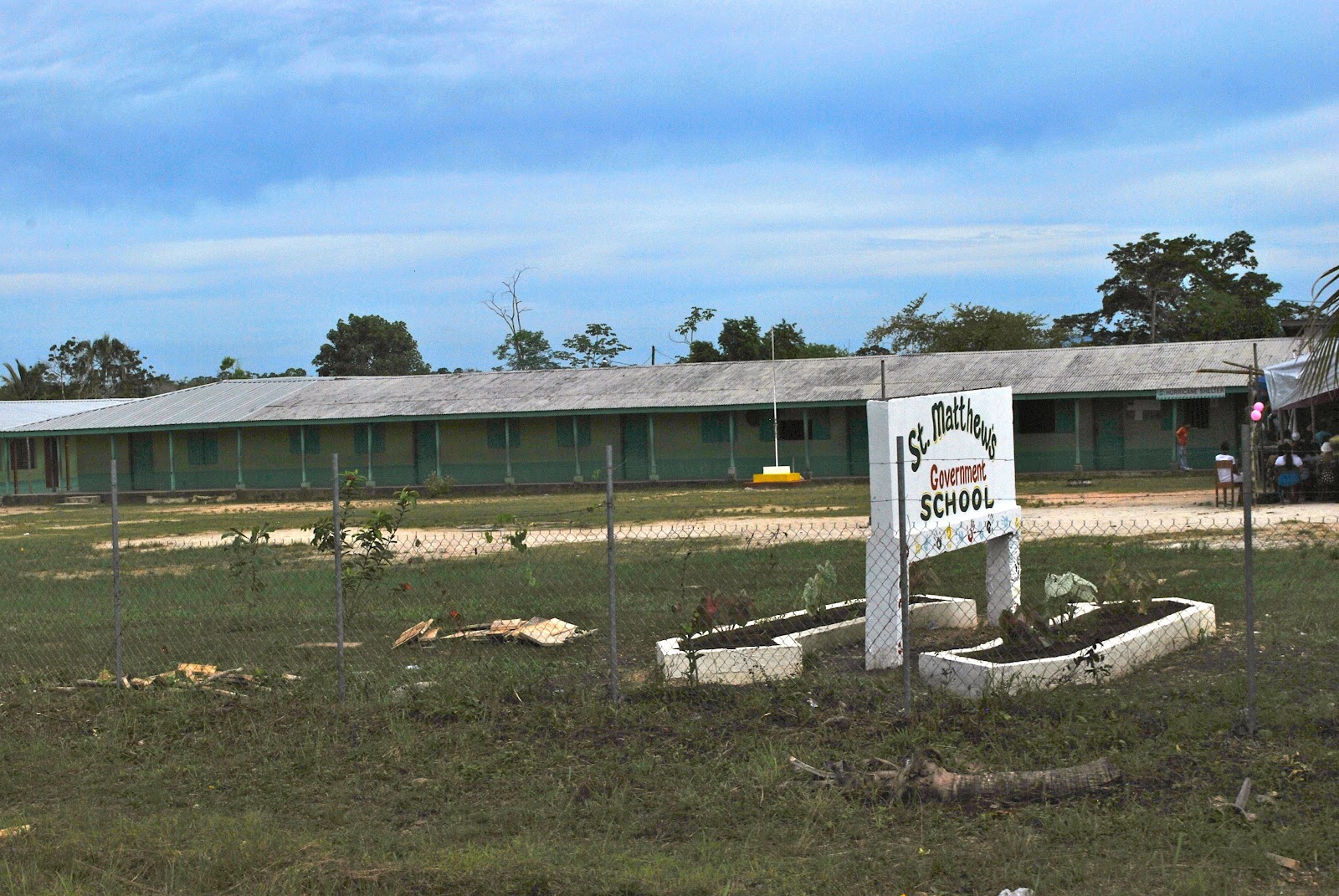
I noticed the building and its bright colors on our arrival in Hopkins as we made our way south to find our hostess Ingrid. It stood alone on a large parcel of land that also contained a school and playground. We'd been in Belize for nine days by that time and I'd seen a number of schools. Each village had its own primary school, which corresponds with our version of a K-8 building. All pretty much the same: long low buildings with door and window openings for each classroom in the row; scrubby playgrounds with little or no equipment; two-door outbuilding for the bathroom; a feeling of age and fatigue radiating from the grounds.

It wasn't until I saw Miss Bertie's Library that I realized I hadn't seen any other libraries in any of the many villages we passed through. And I certainly hadn't seen anything school related that was that bright and inviting. The decorations had a distinctly American flavor, which intrigued me as well.

Because Hopkins is a village itself, we either drove or walked past Miss Bertie's several times during our week there. To my disappointment the library was never open. My heart lifted a bit every time I saw the bright building though, and I was curious about the story behind it.

Strangely, it didn't occur to me to ask anyone during our week in Hopkins. In part I think because I continued to struggle with my feelings of unease about being in Belize as a prosperous American. Nothing in Hopkins did anything to alleviate those feelings.

I had decided it wasn't the poverty that was the source of my disequilibrium. I grew up poor (wood for heat and cooking, no washer or drier, most of our food from the land we lived on). There is still comparable poverty in America, and while I don't necessarily see poverty that extreme every day, I'm aware it exists, I care, I do what I can to help. I don't walk around wearing my awareness like a wool shirt on a hot day. And I certainly don't feel like that aspect of my childhood hurt me in any way.

I considered the possibility that the discomfort came from being "clear" (what light-skinned people are called) in a country full of every shade of beautiful brown imaginable. Except for our hosts who were primarily clear, our fellow guests at the lodges where we stayed, and our fellow travelers on the excursions we took, we rarely saw other clear skin. Not driving around, not walking the streets of the towns we visited, not even in the occasional gift shop. But no, that wasn't it either. I like being surrounded by people who look different from me, who have different life experiences, who have different world views. That's a big part of why I love to travel.

Although the travel guide described the people of Hopkins to be warm and welcoming, we did not find that to generally be the case. They were warily civil when we said hi first. But no one of color ever initiated a greeting or a conversation. Often our waves or greetings were ignored completely. Even when we ate at restaurants owned by locals, there was no sense that the people who served us were actually glad to have our business. I engaged everyone within conversational distance, and while my many questions were answered politely, and I even managed to elicit smiles, I never felt like I broke through a really tough reserve.

On our last day we were talking to the caretaker, a cheek-kissing French-Canadian chiropractor named Yves. He asked how we'd liked our time in Hopkins, and was visibly shocked when I told him of our feelings of discomfort.

"No one has ever said that before. Everyone tells us how polite the locals are when they're spoken to." Then after thinking for a minute he continued. "The locals have seemed less happy in the last couple of years. Things have gotten harder for them. They have less money than they had before. Maybe that's what's going on."

And at that moment I got what was bothering me.

We as American tourists brought our money into a country where most of the citizens would not benefit from that largesse. The enormous homes we saw being built on the seashore did not belong to the locals, but rather to Americans who saw a chance at less expensive luxury. The travel guides which invited us to come and enjoy the incredible resources of this edenic country did not ask the locals if they wanted tourism to become the number one industry in their country. And there seemed to be nothing in place, at least that we could see, that could break the dam separating the very rich from the very poor.

While I grew up in poverty, I always knew of the many opportunities available to me to move out of poverty. I knew that if I worked hard and got a good education, my life could be better. My parents worked hard to provide a life where a good education was the primary goal, the highest expectation. I nourished myself with endless books, and found both hope and salvation in magical combinations of words. My inherent sense of curiosity thrived in those conditions, my need to ask questions, to know whatever is unknown.

Shortly after our conversation with Dr. Yves, we found Ingrid, our German hostess, to pay our bill. I asked about Miss Bertie's Library.

"Oh, that's kind of a sad story," Ingrid answered. She went on to explain that Miss Bertie was a 72 year old Peace Corps volunteer who had been working with the primary school in Hopkins. Miss Bertie was appalled that there were no books for the kids, so she created the library I'd asked about. Then just a couple of years ago she'd been found dead in her home. Since that time local women had taken over.

When we got home I did some research on education in Belize. While their system might not be as sophisticated or developed as ours, the stated purposes are very much the same. At the highest level, it is understood that a good education is the key to helping the citizens of Belize to find a way to a better life, to help them have hope, to diminish the huge discrepancy between the many poor and the few rich.

Miss Bertie clearly understood that when she created the library that the locals gave her name to after her death. While Ingrid didn't say, I'm guessing Miss Bertie was a retired American school teacher with a passion for reading and children. A passion so strong she was willing to spend her last days in a village that was surely difficult to become accepted into, working with children who had little experience with books or hope of a brighter future.

Another thing my research revealed was that Belize has a public library system with 18 branches serving a population of just over 350,000. The system in Clark County, where I live, has 13 branches serving around 430,000 people. A country that cares that much about books is going to be okay.

I am left with great hope for the people of Belize, along with a respect and admiration that continues to grow in these weeks since our return. Books and education—two of the things most central to my own life—are the key. And the willingness and heart of just one teacher to provide those, no matter the circumstances.


Friday, July 20, 2012

Belize - What the Cameras Didn't Catch

By the time we got home from our trip we had taken over 1700 pictures between the two of us. That's about 100 pictures a day. After a couple of weeks of work, I've got the number down to 1100, ready to be shown to anyone lucky enough to ask to see pictures of our trip to Belize. Even so, there were a number of photos that didn't get taken. Here's what we missed:

Close-ups of vivid avian colors in the wild. The scarlet macaws are endangered and hard to find. Green parrots wouldn't sit still long enough. And you already know the toucan story.

The woman washing her clothes, in her yard, on a stone slab, just yards away from where we turned into a new and luxurious resort where we went zip lining.

The river we drove by a number of times where there were six large flat stones set up for washing clothes, always in full use. A short distance up the river from the women doing laundry, we saw men bathing. One time we drove by to find a car immersed in the river being washed with great enthusiasm by a handful of young men.

The table set up by the side of the road, just outside a prison, where men in orange suits were selling products (including some nice looking furniture) I'm guessing they made in the prison. We didn't stop, but I sort of wish we had.

A young girl crossing the road in front of us with a cereal bowl balanced on her head. Our guide laughed and said she was practicing for adulthood.

Just a couple of days later we saw a woman walking in the middle of the main road in Hopkins, bare feet dusty red, a scowl scorching the air around her, hands swinging, plantains draped on her head— like Medusa with fat yellow snakes.

The two boys, about three and five, standing in the street after dark on a Saturday night in Hopkins, asking, "You got dollah?" as we walked by. We didn't have dollah, but I couldn't quite get comfortable with how they'd learned to ask that in the first place.

A man trudging up the highway carrying a load of wood, nearly as big as he was, on his back, supported by a head strap, just as the Mayas carried anything heavy hundreds of years ago. With all of their brilliance, the Maya did not have the wheel.

Incredible thunder storms, lightning lighting up the sky with a force and fury I've never experienced here. At the same time, lightning bugs flitting and blinking in the night air, all to the music of pulsing cicadas and chuckling frogs in the background.

The bright yellow police station in Hattieville where we were caught in a traffic check. Cars were being stopped going both ways through town and policemen were checking papers. We were asked to produce proof of insurance by a man who looked like Idi Amin, who did not smile the whole time he studied our papers, who studied our papers like he was memorizing them, and who only handed them back when another policeman came along side and told him it was okay. That one did smile and wish us a good day. I wanted more than anything to take pictures during the whole thing, but figured it might not have been a good idea.

The sounds. I tried to record the howler monkeys and parrots and motmots, but it didn't work. And no recording could have captured the magic of lying in bed on a morning surrounded by the wild wonder of that chorus.

The experience of picking a Valencia orange from a tree and eating it right there, barely able to contain the juice as it exploded from the membranes.

Walt and I standing under a mango tree, waiting out the rain, at Lubaantun, our last and favorite Maya ruins, kissing like we were new.

We've been home for two weeks now. In many ways, because of these reflections and all the work with the pictures, a big part of me has still been in Belize. I dream about it. I miss some of the people we met. Every day I remember and re-feel and re-see. I have one more story to tell, one last bit of reflecting, before I'm ready to return fully to the Pacific Northwest, a place I've come to love even more as I've explored Belize. I'm so glad you've all been here to share with me.

Wednesday, July 18, 2012

Belize the Beautiful

As much as it is everything in the last post, Belize is also one of the most breathtaking places I've ever experienced. 


A house in Hopkins we walked by every day, and every time it made me stop.

Sunrise at Crooked Tree

A small Ceiba tree, considered sacred by the Maya. The branches hold up the sky. The roots connect with the underworld.

Soldiers were at two of the ruins we visited. Boys with big guns, and equally big grins.

Silk Cayes where we went snorkeling. Tropical postcard perfection.

Walt had so much fun shooting birds. One of  many incredible photos.

El Castillo at Xunantunich. We climbed to the top of that!

Ivar (ee-var'), one of the many guides who led us, taught us, and entertained us.  True ambassadors, every one.

Shot while we drove around San Ignacio

At the Community Baboon Sanctuary (where they call Howler Monkeys baboons for some unknown reason), the monkeys live in a wild made possible by the cooperation of the many landowners in the area. 

The Hummingbird Highway, our last morning in Belize.

Green Iguana in the wild.

And another - these prehistoric monsters were everywhere, yet every time we saw one was an event.

Kids on the  main street of Hopkins.

Champagne cup mushrooms seen hiking through the jungle.

A sunrise from the beach outside our house in Hopkins.

I felt like I should know this tree, but do not. They were common in the south.

You'll need to expand this for full effect. Oropendola nests with a bird, also known as a Yellow Tail, flying toward a nest.


The pier in Placencia.

A random house in Hopkins.

Sunrise from our deck in Hopkins.


Bromeliads (air plants) grew everywhere, some on power lines, some enormous like this one. Notice the vulture  whose head is the same color as the flowers.

The market in San Ignacio, one of my favorite experiences in Belize,  with my favorite guy.

We didn't follow this sign into the jungle, as the trail was big rocks, going straight up.  For me this picture is a reminder  that I'm living my life This Way. 

Monday, July 16, 2012

Not Kansas Anymore Moments


Many Amish and Mennonite settlements in Belize

$1Bz for entrance and a wad of paper - at the market in San Ignacio

All the cemeteries were above ground - a tradition one of our guides said.

My first of five pyramids.

I was disappointed they were never open.

Thorough!

We took turns holding him before this shot. He liked Walt better.

Just the way it sounds.

I wonder where they were before 1981.

Do you just knock on the door?

Omar himself served us lobster for lunch that had been caught that morning.

Much later we did see people washing a car up to its fenders in a river - not this one, though.

Every village had a school that looked much like this one.  Most were church schools.

This made me laugh every time we drove by. It was never open.

They were also called pedestrian ramps and speed bumps, but we liked this the best.
He turned out to be really nice, but had the intimidation thing in spades.

Straight into the jungle.